
HOW LONG DOES EPOXY FLOORING LAST? UNDERSTANDING THE LIFESPAN AND DURABILITY OF EPOXY
You’ve just selected the perfect location for your brand-new manufacturing facility. You noticed the floors looked a bit beat up.
You’ve heard good things about epoxy flooring from other manufacturer friends.
But how long will it last? Is it something you’ll need to replace often? Is it really worth the cost?
Don’t worry. We’ve got your answers here.
Keep reading to learn how long epoxy floors typically last, five ways you can extend the life of your floor, and answers to common questions.
Table of Contents
How Long Does An Epoxy Floor Last?
The typical lifespan of an epoxy floor can range from 10-20 years, but can be affected by several factors, such as:
- Proper cleaning and maintenance
- Structural integrity of the concrete or subsurface
- Type of top coat
- Any additives mixed in
- The level of use
- Type of work
- And more
If you’re considering installing epoxy floors in your greater Kansas City commercial or industrial location, let our epoxy flooring experts at Treadwell help you decide what flooring solution is best for your business. Contact us today and discover why so many area businesses consider us the premier epoxy flooring option.

5 Factors That Determine How Long Epoxy Flooring Lasts
#1: The Structural Integrity of the Existing Concrete
When determining how long your epoxy floor will last, you’ll need to consider the condition of the concrete it’ll be laid on.
The concrete must be in good condition with no structural issues, and any issues must be corrected before the epoxy flooring can be laid. Common issues include:
- Settling or shifting foundations: When a foundation settles unevenly, it can cause the concrete slab to shift, which could cause the epoxy floor to crack and fail.
- Subfloor cracks: Over time, both preexisting and future cracks in the subfloor will eventually show through the epoxy coating.
- Hydrostatic pressure: Excess moisture in the soil beneath the concrete slab could lead to the water vapor being pushed through the porous concrete and getting trapped underneath the epoxy, which could lead to the coating bubbling and peeling.
- Improper concrete curing: If the concrete subfloor is not given enough time to cure and dry properly, it can also cause moisture buildup underneath the epoxy coating.
The concrete should also have the structural integrity to withstand at least 3000 PSI. Any less might not be able to support the floor.
#2: Proper Prep Procedures
It’s vital to properly prepare the concrete surface before the floor is laid. You’ll need to repair any cracks, chips, or blemishes. It also needs to be free of oil, dust, dirt, sand, and other small debris.
Failure to properly prep the concrete surface can lead to bubbling, peeling, or delaminating. Any existing sealants or coatings must be removed to ensure adherence.
Proper pre-testing for moisture and certain mineral levels is also important.
#3: How the Space Is Used
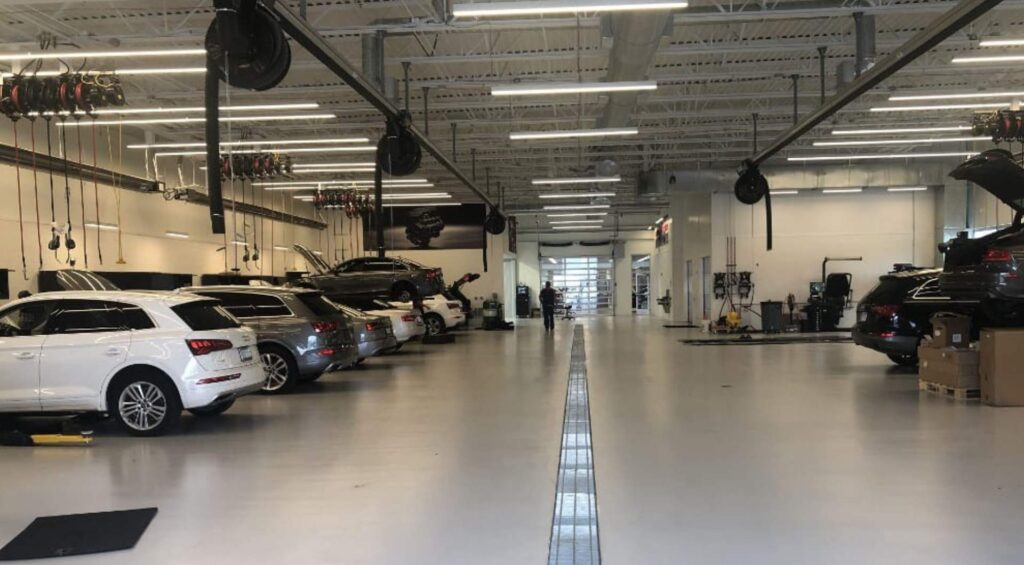
The type of industry and level of beating the floor will take is also an important factor to consider. Floors that will experience heavy vehicle traffic — like repair shops — will need a different type of top coat than a food or beverage manufacturer, which will include extreme heat and chemical exposure.
To help maintain the epoxy’s flexibility, surface integrity, and adhesion to the subsurface, it’s important to maintain a temperature of 55–85 °F and a relative humidity level below 75%.
#4: Installing the Right Top Coat
Epoxy floors usually require a top coat to extend their life and durability. Certain top coats and additives are used in different environments because they’re designed to handle different kinds of stress.
Aliphatic polyurethane (PU) is often used in high-traffic areas, like:
- Warehouses
- Garages
- Showrooms
- Aircraft hangers
- And more
While also being the best protection against UV rays, polyaspartic (or polyurea-polyaspartic hybrid) has the fastest turnaround time — usually ready in 24 hours.
Since it’s formulated for chemical resistance and high temperature exposure, Novolac epoxy top coat is recommended for:
- Chemical-processing plants
- Laboratories
- Battery rooms
- Food/beverage facilities
Need some help deciding what flooring to choose? Look no further than Treadwell, Kansas City’s premier commercial and industrial flooring experts. After an initial consultation, we’ll give you our professional opinion and recommendations.
#5: Regular Cleaning & Maintenance
As soon as your floor is laid, you should put together a cleaning schedule to help extend its lifespan. You’ll want to sweep up any dirt and debris daily, and fully scrub it weekly. We recommend using a scrubbing machine — it correctly dilutes the pH-balanced cleaning solution with water, avoiding the guesswork.
You should clean up spills immediately — the floor can get slippery because the floor and top coat are non-porous and won’t absorb them. And avoid harsh chemicals that can damage it.
Commonly Asked Questions About How Long Epoxy Floors Last
Are Epoxy Floors Worth It?
Yes! These floors are:
- Highly durable
- Easy to maintain
- Enhance safety
They are:
- Chemical-resistant
- Versatile
- Customizable
They regularly outperform bare concrete in environments with:
- Chemical spills
- Oils
- Acids
- Alkalis
They also protect the substrate below and prevent deep contamination, and meet FDA and USDA standards for food processing facilities due to their easy cleaning and don’t harbor dirt, moisture, or bacteria.
Because of their long lifespan, they’re considered to have a high ROI and are well worth the cost.
How Can I Extend the Life of My Epoxy Flooring?
Your epoxy floor’s life can be extended by:
- Sweeping daily
- Scrubbing weekly
- Using proper cleaning solutions
- Cleaning up spills immediately
- Maintaining them properly
- Avoiding harsh chemicals
- Limiting UV light unless using the proper top coat
- Using protective mats under heavy equipment
- Reapplying the top coat every few years
Does Sunlight Affect How Long Epoxy Floors Last?
Yes, constant exposure to sunlight and UV rays can cause fading and yellowing over time. If your floor is in a sunlit space, consider using a UV-resistant coating or adding a polyaspartic (or polyurea-polyaspartic hybrid) top coat for better protection.
Continuous sunlight may make the epoxy prone to cracking or powdering as the surface epoxy becomes brittle.
How Do I Know It’s Time To Repair or Replace My Epoxy Floor?
Peeling, fading, cracking, or dull areas where the coating has worn away are all signs that it’s time for some repair work. If the damage is in a centralized location, spot repairs might be sufficient; however, if larger sections are damaged, you might need a full resurfacing.
The experts at Treadwell can answer any questions or concerns you may have about your epoxy flooring. They’ll diagnose any issues and offer their professional recommendations.
Treadwell: Commercial and Industrial Epoxy Flooring Solutions That Are Built To Last
If you’re looking for a reliable, no-nonsense floor surface for your commercial or industrial business, look no further than Treadwell.
If your current epoxy flooring is looking worse for wear and already has damage, you’re in luck; we can help with that, too!
At Treadwell, we repair and install epoxy floors, as well as commercial polished concrete flooring and gypsum underlayment throughout the Kansas City metro area.
Contact us today for the first step on your epoxy flooring path.
